Family Law
Divorce, custody, maintenance, inheritance
Advice and advocacy, with rigour and care.
Two lawyers in Rabat · family, property, business, criminal · international clients.
The Firm
A family firm in Rabat, led by two sister lawyers trained in Morocco and France.
Advice before disputes, representation before every Moroccan court.
Practice Areas
Divorce, custody, maintenance, inheritance
Contracts, compensation, debt recovery
Sales, leases, land titles, syndic
Companies, contracts, cheques
Victims and defence, every stage
Dismissal, workplace accidents
Claims against public authorities
Compensation, insurers
Consultations, contract drafting
Our Lawyers
Lawyer
Dr. Amal Elkhalfi holds a Doctorate in civil and commercial law from the University of Perpignan Via Domitia (France), awarded with highest honours and the jury's congratulations, for her thesis on joint and several obligations in Moroccan law, a contribution to the history of a Romano-Islamic institution. She practised as a lawyer in France before settling in Morocco with her family. Before law, she graduated in interior design.
Lawyer
Lawyer at the Rabat Bar, graduate of Mohammed V University, Rabat.
Organisation
FAQ
The Moudawana provides several routes: divorce initiated by the husband under judicial supervision, divorce by mutual consent, khul' divorce, divorce for discord (shiqaq), which either spouse may request, and judicial divorce requested by the wife on other grounds, such as harm, failure to provide maintenance or absence.
The court first attempts reconciliation. The Family Code provides that the request must be decided within six months of filing. The actual duration depends on each case.
Custody is granted to the mother, then the father, then the maternal grandmother, always in the child's best interests. It lasts until legal majority, and a child aged fifteen may choose which parent will have custody.
Each spouse has separate assets. Spouses may agree, in a document separate from the marriage contract, on how property acquired during the marriage is managed and shared. Without an agreement, the general rules of evidence apply, taking into account each spouse's work, efforts and the burdens they carried to grow the family's assets (article 49 of the Family Code).
Inheritance is governed by Book VI of the Family Code, following Islamic law (Maliki school). Each heir's share depends on the degree of kinship, and a person may bequeath up to one third of their estate to non-heirs. There is no inheritance between a Muslim and a non-Muslim (article 332). We assist with the certificate of heirs and the division of the estate.
A husband inherits half of his wife's estate if she has no children, and a quarter if she does. A wife inherits a quarter of her husband's estate if he has no children, and an eighth if he does; this share is divided among wives if there are several.
Moroccans living abroad may marry according to the administrative procedures of their country of residence, in line with the Family Code. A copy of the marriage certificate must be filed with the Moroccan consulate within three months (articles 14 and 15), which forwards it to the civil registrar and the family court. Contact us through the form, by phone or by email for help with this procedure.
The Criminal Code (article 503-1, amended by Law 103-13) punishes harassment in public spaces or through written, phone or electronic messages with one to six months' imprisonment and a fine of 2,000 to 10,000 dirhams. The penalty rises to three to five years and a fine of 5,000 to 50,000 dirhams if the victim is a minor, or if the offender is a parent, close relative, a person with authority over the victim or responsible for their care.
The Criminal Code punishes indecent assault with violence with five to ten years (article 485) and rape with five to ten years (article 486). The penalty rises to ten to twenty years if the victim is a minor, incapacitated, disabled or pregnant, and further if the offender is a parent or a person with authority over the victim (article 487). Indecent assault on a minor without violence is punished with two to five years' imprisonment (article 484).
The Criminal Code punishes simple theft with one to five years' imprisonment and a fine (article 505). Penalties increase with aggravating circumstances (night, violence, break-in, several offenders): five to ten years with one circumstance (article 510), more with two or more (article 509), and life imprisonment if the thief is armed (article 507).
The Dahir of 21 May 1974 on drug addiction punishes trafficking (import, production, transport, possession for trafficking) with five to ten years' imprisonment and a fine of 5,000 to 500,000 dirhams (article 2). Drug use is punished with two months to one year and a fine of 500 to 5,000 dirhams, or either penalty (article 8); users may be offered addiction treatment.
Law 09-09 on violence at sports events, part of the Criminal Code (articles 308-1 onwards), punishes taking part in violence during or around matches that causes injury with three months to two years' imprisonment and a fine of 1,200 to 10,000 dirhams (article 308-2), with heavier penalties if someone dies. Inciting hatred or discrimination is punished with one to six months (article 308-5). Courts can ban offenders from matches for up to two years. Violence outside sports events falls under general criminal law.
Yes. The Criminal Code imposes heavier penalties for violence against children, especially when the child is young or the offender is a parent, a person with authority over the child or responsible for their care. Anyone can report it to the public prosecutor, the police or the gendarmerie, and child-protection units operate in the courts.
Yes, they can be used. Moroccan law recognises electronic documents as evidence (Law 53-05). The court assesses the weight of messages and screenshots case by case; sometimes they are supporting evidence that needs other proof. To strengthen them, have them recorded by a judicial officer (bailiff), keep the original phone and do not delete the conversations.
Yes. Foreigners can buy apartments, villas, commercial premises and land within urban areas, through a notarial deed registered with the Land Registry. Agricultural land outside urban areas cannot be bought by foreigners, unless a certificate of non-agricultural use (VNA) is obtained for a non-agricultural project. Collective (soulaliyate) land, habous property and State public land cannot be sold. We recommend checking the land title before any purchase.
Law 18-00 governs co-ownership of buildings such as apartment blocks and residences. Each owner owns their unit and a share of the common parts (stairs, lift, roof). The owners form a co-owners' association, whose general meeting elects the syndic, who manages and maintains the building and collects service charges. Each owner must pay their share, and the syndic can go to court to recover unpaid charges.
Yes. Elkhalfi Law & Legal Consulting acts across Moroccan law: family, civil, real estate, commercial, criminal, employment, administrative and road accident cases, before the courts of first instance, courts of appeal, commercial courts and administrative courts.
Yes. Lawyers are bound by professional secrecy under the law governing the profession. Everything you share with us stays confidential.
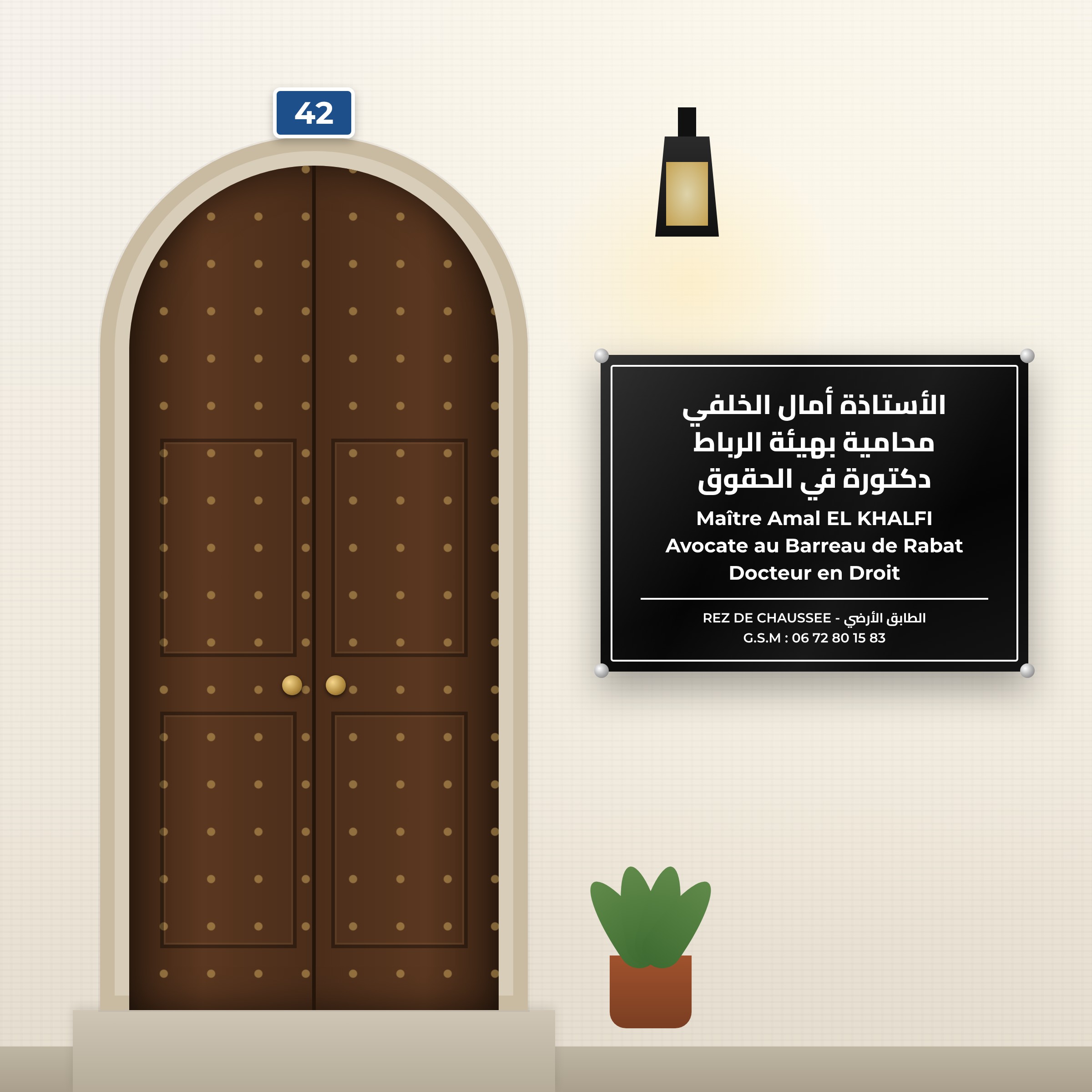
The office is in Rabat: 42 Abdelkrim Diouri Street, Madagascar Avenue, ground floor. You can book an appointment through the contact form on this page or by phone.
Contact
Tell us briefly about your situation. We will get back to you to arrange an appointment at our office.
Monday – Friday, 9:00 – 18:00